Nogales Bey: Rafael de Nogales Méndez, el hombre sin mundo interior
Biografía en tres actos · Venezolanos universales
Peleó en guerras ajenas de tres continentes, vio con sus propios ojos un genocidio y lo escribió. Murió en un hotel de Panamá, y su ataúd pasó días olvidado entre mercancías en La Guaira. La vida de Rafael de Nogales Méndez, contada como una película.

PPrólogo: un cajón en la aduana
INTERIOR · SÓTANO DE LA ADUANA DE LA GUAIRA · JULIO DE 1936 · DÍA
Huele a sal, a café en sacos y a madera húmeda. Entre las cajas de mercancía que esperan su turno hay una más larga que las otras. Llegó el 24 de julio en la bodega del vapor de carga Urazio, desde Panamá. Los estibadores pasan a su lado cargando bultos y no se detienen. Nadie del Ministerio de Relaciones Exteriores ha venido a buscarla.
Es un ataúd. Adentro está un hombre de cincuenta y ocho años que los soldados turcos llamaban Nogales Bey. Un mariscal británico escribió el prólogo de uno de sus libros. Un emperador alemán lo condecoró. Vivió entre vaqueros de Arizona, marineros rusos y oficiales prusianos, y escribió en español y en inglés para lectores de medio mundo.
Pasan los días. Al fin, dos periodistas, uno de El Heraldo y otro de La Esfera, encuentran el cajón arrumbado y lo cuentan en sus diarios. Solo entonces Caracas se entera de que Rafael de Nogales Méndez ha vuelto a casa.
¿Cómo termina un hombre así en el sótano de una aduana? Para responder hay que subir a la montaña, a una ciudad andina de calles empinadas, y retroceder cincuenta y nueve años.
IActo I. El muchacho que se cambió el nombre1877 · 1914
EXTERIOR · SAN CRISTÓBAL, TÁCHIRA · 14 DE OCTUBRE DE 1877
Nace con otro apellido. Lo bautizan en la iglesia de San Sebastián como Rafael Inchauspe Méndez. Su padre, Pedro Felipe Inchauspe, tiene minas de cobre en Seboruco, cafetales en El Abejal y acciones del Gran Ferrocarril del Táchira. Su madre, Josefa Méndez Brito, viene de Barinas, de una familia que había dado caballos al ejército de Bolívar.
El apellido paterno es vasco. Intxauspe quiere decir, más o menos, «bajo el nogal». Años después, el muchacho lo traducirá al castellano y se hará llamar Rafael de Nogales. Es su primera invención, y la más duradera: un hombre que se pone nombre a sí mismo.
A los siete años lo mandan a Europa, como a tantos hijos de familias andinas con dinero. Estudia en Alemania, en Bélgica y en España. Aprende idiomas con una facilidad que luego exagerará en sus memorias. Aprende también otra cosa: la disciplina de los cuarteles prusianos.
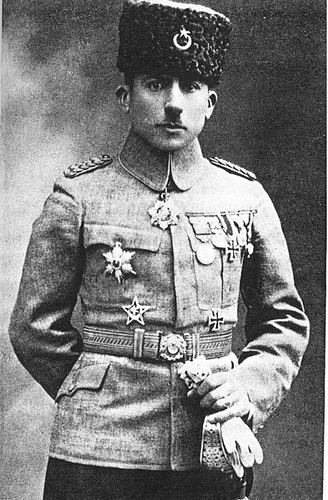
EXTERIOR · CUBA · 1898
Su primera guerra la pelea con uniforme español. Entra muy joven como alférez en la Armada de España y en 1898 está en Cuba cuando los Estados Unidos destruyen lo que queda del imperio español en América. Pierde. Será un hábito: casi siempre elegirá el bando que va a perder, y casi siempre saldrá vivo.
Después, según su propio relato, cruza a México, trabaja de vaquero en Arizona y caza osos en Nevada, donde lo conocen como «Chico Méndez» o «Nevada Méndez». Es la parte de su vida en la que conviene leer con lupa. Más adelante lo veremos.
INTERIOR · CASINO DE MACUTO · NOCHE · 1902
En 1901 ha vuelto a Venezuela. En el Palacio de Miraflores discute a gritos con el presidente Cipriano Castro y le reprocha su manera de gobernar. Castro no olvida. Cuando estalla la Revolución Libertadora, manda a detenerlo.
Lo buscan en un baile, en el casino de Macuto, frente al mar. La orquesta toca, las parejas giran, y Nogales sale por la puerta de atrás, baja a la playa y se va en una lancha, de noche, vestido de frac. Es la escena con la que cualquier director abriría la película.
EXTERIOR · CARAZÚA, LA GUAJIRA · DÍA
En Nicaragua lo recibe el presidente José Santos Zelaya y le da lo necesario para invadir Venezuela. Nogales desembarca desde la goleta Libertad en Carazúa, una aldea de la Guajira. Lo derrota el general Antonio Dávila. Herido en una pierna y en un hombro, con fiebre de malaria, vuelve a la goleta por la misma playa por donde había llegado.
MONTAJE · MÉXICO, SAN FRANCISCO, SHANGHÁI, VLADIVOSTOK, ALASKA · 1903-1910
Aquí la película se acelera. En México persigue contrabandistas de armas bajo la protección de Porfirio Díaz. En San Francisco vende su caballo y sus armas para comprar un pasaje a Shanghái. En la guerra entre Rusia y Japón dice haber sido espía doble: emborrachaba a marineros rusos en Vladivostok para sacarles información. En Alaska caza ballenas con los inuit y busca oro. Gana algo, lo pierde todo. Conoce al revolucionario mexicano Ricardo Flores Magón.
Casi todo lo que sabemos de estos años lo sabemos por él. Ese detalle importa, y vuelve en la sección de verificación al final.
EXTERIOR · FRONTERA DE UREÑA · 1911
Ahora el enemigo es Juan Vicente Gómez. Nogales entra por la frontera de Ureña con la promesa de unos fusiles que el gobernador del Táchira nunca le entrega. Huye por el río. Después se alza otra vez y, según sus biógrafos, llega a gobernar Apure durante unos cuarenta y cinco días. Fracasa. Con precio sobre su cabeza, se refugia en Curazao.
Tiene treinta y seis años. Ha peleado en tres países, ha perdido en todos y no tiene patria a la que volver. Entonces, en el verano de 1914, Europa se incendia.
IIActo II. Bajo la media luna1914 · 1919
EXTERIOR · PUERTO DE CALAIS · OTOÑO DE 1914
Llega desde Trinidad buscando una guerra. Francia le ofrece un puesto en la Legión Extranjera con una condición: renunciar a la nacionalidad venezolana. Dice que no. Se ofrece a Bélgica, se ofrece a Montenegro, dos países pequeños que le parecen heroicos. Lo rechazan porque no es ciudadano de un país aliado.
Seis meses después toca la puerta de la embajada otomana en Sofía. Unos oficiales prusianos que lo conocen responden por él. El Imperio otomano lo acepta sin pedirle que deje de ser venezolano. Así, por terquedad y por un pasaporte, un tachirense termina con el uniforme del sultán.

EXTERIOR · ERZURUM, ANATOLIA ORIENTAL · ENERO DE 1915 · NIEVE
Llega al Tercer Ejército otomano en el peor momento posible. Pocas semanas antes, en Sarıkamış, ese mismo ejército ha perdido decenas de miles de hombres contra los rusos, muchos de ellos muertos de frío. Nogales llega a un ejército derrotado, en un país cuya lengua apenas entiende, a pelear por un sultán que nunca verá. Sus soldados le dan un nombre: Nogales Bey.
EXTERIOR · VAN · ABRIL DE 1915
Ahora la película cambia de color. En la primavera de 1915, Nogales está en Van, cerca de la frontera persa, donde los armenios de la ciudad resisten encerrados en su barrio. Él forma parte de las fuerzas sitiadoras. Al principio desconfía de los nacionalistas armenios y lo dice en su libro. Lo que ve en los días siguientes le cambia el juicio.
Ve que la turba y las autoridades civiles atacan a la población. Ve que los asesinatos se hacen de noche, con ayuda de milicias kurdas. Cuando intenta detener una matanza, el alcalde le responde que solo cumple una orden del gobernador general: exterminar a todos los varones armenios de doce años en adelante.

En la isla de Aghtamar, en medio del lago de Van, entra a la catedral armenia de la Santa Cruz, una iglesia de piedra rojiza del siglo X. Adentro encuentra los cadáveres de los sacerdotes.

INTERIOR · DESPACHO DEL GOBERNADOR · DIYARBAKIR · 26 DE JUNIO DE 1915
Es la escena más fría de la película, y ocurre sentada. Nogales visita al gobernador de Diyarbakır, Mehmed Reşid, al que la historia recordará como «el carnicero de Diyarbakır». Según el relato de Nogales, Reşid le cuenta con calma que ha recibido un telegrama del ministro del Interior, Talat Pachá. Tres palabras: quemar, destruir, matar.
Nogales escribe que vio escenas de las que «ningún cristiano debía ser testigo». Pide la baja. Dice que el mando turco planeaba envenenarlo porque sabía demasiado. Un historiador turco, Mehmet Necati Kutlu, encontró un documento de octubre de 1915 en el que un general otomano afirma que Nogales no representa ningún peligro aunque cuente lo que vio. El veneno queda en duda. Lo que vio sigue ahí.
MONTAJE · MESOPOTAMIA, BELÉN, GAZA, SINAÍ · 1916-1918
No se va. Sirve en Mesopotamia, en la campaña de Kut, en 1916. Ese mismo año aparece en Belén, retratado junto a un pintor alemán. En 1917 manda caballería en el frente de Gaza, en Palestina, contra los británicos. Él cuenta que fue gobernador militar del Sinaí y que en el desierto se cruzó con un coronel inglés llamado T. E. Lawrence: se miraron en silencio y siguieron su camino.


En octubre de 1918 el Imperio otomano se rinde. Los aliados le dan a Nogales un salvoconducto para salir de Constantinopla. Él atribuye ese gesto a la gratitud de oficiales británicos cuyos compañeros prisioneros había protegido. Ha peleado cuatro años por un imperio que acaba de dejar de existir.
IIIActo III. La pluma y el olvido1919 · 1936
INTERIOR · CLUB ESPAÑOL, CAVENDISH SQUARE, LONDRES · NOCHE · AÑOS VEINTE
Frac impecable, monóculo, un vaso en la mano. En el club español de Cavendish Square, Nogales conversa con Ramón Pérez de Ayala, Américo Castro, Fernando de los Ríos, los poetas Manuel Altolaguirre y Concha Méndez. El escritor escocés Robert Cunninghame Graham lo admira. Gómez sigue en el poder y Nogales no puede volver a Venezuela, así que hace lo único que le queda: escribir.
En 1924 publica Cuatro años bajo la Media Luna. Dos años después sale en inglés, en Nueva York y Londres, como Four Years Beneath the Crescent. Es el testimonio de un oficial del propio ejército otomano que cuenta, con nombres y fechas, las matanzas de armenios. El traductor turco del libro lo acusa de ser un extranjero que muerde la mano que le prestó la espada. Armenios y turcos citan el mismo libro para defender versiones opuestas. Pocas obras de un venezolano han tenido lectores tan enfrentados.

EXTERIOR · NICARAGUA OCUPADA · 1927-1928
El viejo soldado vuelve a América como corresponsal. En Nicaragua, ocupada por los marines estadounidenses, entrevista a Augusto César Sandino. De ese viaje sale El saqueo de Nicaragua (1928), una denuncia de la intervención. Siguen Memorias de un soldado de fortuna (1932) y Silk Hat and Spurs (1934), este último escrito directamente en inglés.
El prólogo de Silk Hat and Spurs lo firma el mariscal Edmund Allenby, el general británico que derrotó a los otomanos en Palestina. Allenby lo llama «un enemigo valiente, y ahora un amigo de confianza». Mientras tanto, los diplomáticos de Gómez en Europa reciben instrucciones de aislarlo y lo describen en sus memorandos como «comunista y peligroso terrorista». Lo respeta el hombre que lo venció en el campo de batalla. Lo persigue el gobierno de su propio país.
EXTERIOR · ADUANA DE LAS PIEDRAS, FALCÓN · 1936 · CALOR
Gómez muere en diciembre de 1935. Nogales vuelve al año siguiente, con cincuenta y ocho años, convencido de que el nuevo gobierno de Eleazar López Contreras aprovechará lo que sabe. Unos oficiales jóvenes piden para él el cargo de Inspector General del Ejército. El gobierno le da otra cosa: la administración de la pequeña aduana de Las Piedras, en la península de Paraguaná.
Es un puesto menor y mal pagado. La humedad le agrava la artritis. Va a los baños termales de Las Trincheras, vive a ratos en un hotel alemán de Valencia, y al final renuncia, ofendido. El gobierno lo envía entonces a Panamá con una misión de trámite: estudiar la gendarmería panameña. Guarde el lector un detalle para más tarde. El último empleo que Venezuela le dio a Nogales fue en una aduana.
INTERIOR · HOTEL PANAMÁ, HABITACIÓN · 10 DE JULIO DE 1936 · 2:45 DE LA TARDE
Llega enfermo, con las manos inflamadas. El 7 de julio lo operan de la garganta. Tres días después amanece con una neumonía grave, complicada con una parálisis bulbar. Muere a las tres menos cuarto de la tarde. Entre sus cosas encuentran un cheque de 1.615 dólares. Con ese dinero se paga el embalsamamiento y el viaje del cuerpo.
El resto ya lo conocemos. El vapor Urazio, el sótano de la aduana de La Guaira, los sacos de café, los periodistas. El hombre que terminó su carrera administrando una aduana pasó sus últimos días sobre la tierra en otra, guardado entre la mercancía.
EEpílogo: una corona de roble
EXTERIOR · CEMENTERIO GENERAL DEL SUR, CARACAS · 2 DE AGOSTO DE 1936
Lo entierran sin honores militares. El presidente no va. Asisten el ministro de Alemania y un grupo de escritores venezolanos que pronuncian discursos contra el olvido. Sobre el ataúd ponen una corona de hojas de roble y laureles dorados que ha llegado desde Holanda. La envía Guillermo II, el antiguo emperador alemán, desde su exilio. La tarjeta, según la prensa de esos días, lo llama uno de los caballeros más valientes y nobles que había conocido.
En sus memorias, Nogales dejó una frase que parece una lápida: «El mundo interior no existe para el hombre de acción». Pero el hombre que escribió esa frase llenó cuatro libros. Contó lo que vio en Van y en Diyarbakır cuando habría sido más cómodo callar. Ese testimonio, publicado en 1924, todavía se cita en los estudios sobre el genocidio armenio. La espada se la prestaron otros. La pluma fue suya.
❦La moraleja
El valor sin una causa propia termina sirviendo a causas ajenas. Nogales tuvo coraje de sobra y lo puso al servicio de España, de Japón, de un sultán. Casi siempre perdió.
Pero la historia guarda otra lección, más fina. Un hombre puede equivocarse de bandera y aun así decir la verdad sobre lo que vio. El soldado se discute. El testigo sigue siendo necesario.
§Notas al margen
- El apellido. En euskera, intxaur es nogal y el sufijo -pe significa «debajo». Intxauspe viene a ser «bajo el nogal». Al llamarse «de Nogales», Rafael tradujo su origen vasco y lo convirtió en firma literaria.
- «Bey» no es un grado militar. Es un título de respeto otomano, algo así como «señor». Que lo llamaran Nogales Bey dice cómo lo veían sus hombres. No dice qué rango tenía.
- Antes que Lawrence. Cuatro años bajo la Media Luna salió en 1924. Los siete pilares de la sabiduría, de T. E. Lawrence, se imprimió en edición privada en 1926. El escritor argentino Roberto Arlt escribió sobre las vidas paralelas de los dos.
- ¿1936 o 1937? Algunas fuentes dan 1937 como año de su muerte. Las crónicas de la repatriación y del entierro, fechadas en julio y agosto de 1936, resuelven la duda.
- Un testigo incómodo para todos. Su libro molestó al gobierno turco, a los Estados Unidos (por Nicaragua) y al gobierno de Gómez. Pocos autores venezolanos han logrado enemistarse con tantos poderes a la vez.
✎Aprendizajes para estudiar
- Las memorias se contrastan. Cuando el protagonista es el único que cuenta una escena, hay que buscar otros documentos antes de darla por cierta. Con Nogales, la mitad de las aventuras solo tienen un testigo: él.
- El testigo de adentro pesa más. Su relato del genocidio armenio vale tanto porque viene de un oficial del ejército que lo cometía, y porque confirma lo que contaron misioneros, diplomáticos y sobrevivientes.
- Escribir en la lengua del lector. Nogales publicó en inglés para llegar a Londres y Nueva York. Por eso su nombre se conoce más en el mundo académico anglosajón que en muchas escuelas venezolanas.
- Los países también olvidan. Un ataúd perdido entre mercancías es una imagen de cómo una nación puede perder a sus propias figuras. Recordarlas, con sus luces y sus sombras, es trabajo de cada generación.
✓Verificación de datos
La vida de Nogales está llena de hazañas que repiten blogs, videos y hasta enciclopedias. Revisamos las más citadas contra las fuentes disponibles. Este es el resultado.
Nació en San Cristóbal el 14 de octubre de 1877.
Consta su bautizo del 19 de marzo de 1878 en la iglesia de San Sebastián. Algunas fichas antiguas, incluida la de Wikimedia Commons, dan 1879 por error.
Sirvió como oficial en el ejército otomano durante la Primera Guerra Mundial.
Lo confirman documentos otomanos estudiados por Mehmet Necati Kutlu y la prensa alemana de la época.
Fue general de brigada al mando de doce mil soldados.
Así lo cuentan sus memorias y la tradición venezolana, y la prensa alemana lo llamaba «general». Los artículos turcos basados en archivos lo presentan como binbaşı, es decir, mayor. La cifra de doce mil hombres no tiene respaldo independiente.
Fue testigo del sitio de Van y de matanzas de armenios en 1915.
Su relato coincide en lo esencial con el de misioneros y sobrevivientes, y los historiadores del genocidio lo usan como fuente. Él mismo admite que estaba del lado de los sitiadores.
Reşid le habló de un telegrama de Talat con la orden «quemar, destruir, matar».
No se conoce una copia de ese telegrama. El papel de Reşid en las matanzas de Diyarbakır sí está ampliamente documentado.
El mando turco planeaba envenenarlo.
Un documento de octubre de 1915 citado por Kutlu dice que Nogales no representaba un peligro. No prueba lo contrario, pero debilita la versión.
Fue espía en Shanghái y Vladivostok, vaquero en Arizona y buscador de oro en Alaska.
Ningún documento independiente conocido lo confirma. No hay motivo para descartarlo del todo, ni para repetirlo como hecho.
Se cruzó en silencio con T. E. Lawrence en el desierto.
No hay un segundo testigo. Es una gran escena de cine que descansa solo en su memoria.
El presidente Woodrow Wilson lo llamó «verdugo de Armenia» y le prohibió entrar a los Estados Unidos.
Circula mucho en internet, pero no encontramos ninguna fuente primaria que lo respalde.
Dominaba siete idiomas, entre ellos japonés, chino y coreano.
Escribió libros en español y en inglés, y se movía con soltura en alemán y francés. Lo demás no tiene prueba.
Allenby escribió el prólogo de Silk Hat and Spurs.
El libro existe (Londres, 1934) y el prólogo se puede leer en él.
Su ataúd quedó olvidado en la aduana de La Guaira.
Lo denunciaron El Heraldo y La Esfera a finales de julio de 1936. La corona del káiser también fue reseñada por la prensa caraqueña, según sus biógrafos.
✦El mapa de una vida
Treinta y dos paradas en América, Europa y Asia. Toque un punto para leer qué pasó allí. Los puntos dorados están documentados por otras fuentes; los grises solo los cuenta Nogales.
DocumentadoSolo su palabra
- 11877 San Cristóbal, Táchira. Nace el 14 de octubre como Rafael Inchauspe Méndez.
- 2c. 1884-1897 Lovaina y Bruselas. Estudia en Bélgica, Alemania y España desde los siete años.
- 31898 Cuba. Alférez de la Armada española en la guerra contra los Estados Unidos.
- 4c. 1899 Arizona. Vaquero, según sus memorias.
- 5c. 1899 Nevada. Caza osos y lo llaman «Nevada Méndez».
- 61901 Caracas, Miraflores. Discute con el presidente Cipriano Castro.
- 71902 Macuto. Huye de un baile en lancha, de noche y vestido de frac.
- 81902 Managua. El presidente Zelaya le facilita una expedición contra Castro.
- 91902 Carazúa, La Guajira (ubicación aproximada). Derrotado por el general Antonio Dávila, herido y con malaria.
- 10c. 1902-1903 México. Persigue contrabandistas de armas bajo Porfirio Díaz.
- 111903 San Francisco. Vende su caballo y sus armas para ir a Asia.
- 121903 Shanghái. Dice haber trabajado como espía.
- 131904 Vladivostok. Espía doble en la guerra ruso-japonesa, según su relato.
- 141904-1905 Alaska. Caza ballenas con los inuit y busca oro.
- 151911 Ureña. Entra por la frontera contra Gómez; los fusiles prometidos nunca llegan.
- 16c. 1913 San Fernando de Apure. Gobierna Apure unos cuarenta y cinco días durante su alzamiento.
- 171913-1914 Willemstad, Curazao. Exilio con precio sobre su cabeza.
- 181914 Calais. Rechaza la Legión Extranjera: no quiere dejar de ser venezolano.
- 191914 Sofía. La embajada otomana lo acepta como oficial.
- 201915 Erzurum. Se incorpora al Tercer Ejército otomano tras Sarıkamış.
- 211915 Van. Testigo del sitio y de las matanzas de armenios.
- 221915 Aghtamar. Encuentra a los sacerdotes asesinados en la catedral.
- 2326 jun. 1915 Diyarbakır. Conversa con el gobernador Reşid, el «carnicero de Diyarbakır».
- 241916 Kut. Sirve en el frente de Mesopotamia.
- 251916 Belén. Fotografiado junto al pintor Fritz Grotemeyer.
- 261917 Gaza. Manda caballería contra los británicos.
- 271917 Sheik Zowaid, Sinaí. Dice haber cruzado las líneas británicas y haberse cruzado con Lawrence.
- 281919-1935 Londres. Exilio y escritura: cuatro libros en dos idiomas.
- 291936 Las Piedras, Falcón. Administrador de una pequeña aduana.
- 3010 jul. 1936 Hotel Panamá. Muere de neumonía a las 2:45 de la tarde.
- 3124 jul. 1936 La Guaira. Su ataúd queda olvidado en la aduana.
- 322 ago. 1936 Cementerio General del Sur. Enterrado sin honores militares.
▶Para estudiar: el video
Elegimos esta entrevista porque la protagoniza Mirela Quero de Trinca, la historiadora que escribió su biografía para la Biblioteca Biográfica Venezolana. Son catorce minutos serenos, sin dramatismo, ideales para un aula.
«Perfiles: Rafael de Nogales Méndez», con Mirela Quero de Trinca · Canal MundoUR · 14 min. Para profundizar: la reseña de Cuatro años bajo la Media Luna en el canal Bibliópolis, de Ivo Hernández (42 min).
Biography in three acts · Universal Venezuelans
He fought other people's wars on three continents, saw a genocide with his own eyes and wrote it down. He died in a hotel in Panama, and his coffin lay forgotten for days among the cargo at La Guaira. The life of Rafael de Nogales Méndez, told like a film.
PPrologue: a crate in the customs house
INTERIOR · BASEMENT OF THE LA GUAIRA CUSTOMS HOUSE · JULY 1936 · DAY
It smells of salt, of coffee in sacks and of damp wood. Among the crates of cargo waiting their turn there is one longer than the rest. It arrived on 24 July in the hold of the cargo steamer Urazio, from Panama. The dockers walk past it carrying bundles and do not stop. No one from the Ministry of Foreign Affairs has come to collect it.
It is a coffin. Inside lies a fifty-eight-year-old man whom Turkish soldiers called Nogales Bey. A British field marshal wrote the foreword to one of his books. A German emperor decorated him. He lived among Arizona cowboys, Russian sailors and Prussian officers, and he wrote in Spanish and in English for readers across half the world.
Days go by. At last two journalists, one from El Heraldo and another from La Esfera, find the crate pushed into a corner and report it in their papers. Only then does Caracas learn that Rafael de Nogales Méndez has come home.
How does a man like that end up in the basement of a customs house? To answer, we have to climb into the mountains, to an Andean town of steep streets, and go back fifty-nine years.
IAct I. The boy who changed his name1877 · 1914
EXTERIOR · SAN CRISTÓBAL, TÁCHIRA · 14 OCTOBER 1877
He is born with another surname. He is baptised in the church of San Sebastián as Rafael Inchauspe Méndez. His father, Pedro Felipe Inchauspe, owns copper mines in Seboruco, coffee estates in El Abejal and shares in the Great Táchira Railway. His mother, Josefa Méndez Brito, comes from Barinas, from a family that had given horses to Bolívar's army.
His father's surname is Basque. Intxauspe means, roughly, "beneath the walnut tree". Years later the boy will translate it into Spanish and call himself Rafael de Nogales. It is his first invention, and the most lasting: a man who gives himself his own name.
At seven he is sent to Europe, like so many sons of wealthy Andean families. He studies in Germany, Belgium and Spain. He picks up languages with an ease he will later exaggerate in his memoirs. He learns something else too: the discipline of Prussian barracks.
EXTERIOR · CUBA · 1898
He fights his first war in a Spanish uniform. He joins the Spanish Navy very young as a midshipman, and in 1898 he is in Cuba when the United States destroys what is left of Spain's empire in the Americas. He loses. It will become a habit: he will almost always choose the side that is going to lose, and he will almost always come out alive.
Afterwards, by his own account, he crosses into Mexico, works as a cowboy in Arizona and hunts bears in Nevada, where people know him as "Chico Méndez" or "Nevada Méndez". This is the part of his life best read with a magnifying glass. We will come back to it.
INTERIOR · MACUTO CASINO · NIGHT · 1902
By 1901 he is back in Venezuela. In Miraflores Palace he argues at the top of his voice with President Cipriano Castro and reproaches him for the way he governs. Castro does not forget. When the Liberating Revolution breaks out, he orders his arrest.
They come for him at a ball, in the casino at Macuto, facing the sea. The orchestra plays, the couples turn, and Nogales slips out by the back door, goes down to the beach and leaves in a launch, at night, in tails. It is the scene any director would open the film with.
EXTERIOR · CARAZÚA, LA GUAJIRA · DAY
In Nicaragua, President José Santos Zelaya receives him and gives him what he needs to invade Venezuela. Nogales lands from the schooner Libertad at Carazúa, a village in La Guajira. General Antonio Dávila defeats him. Wounded in a leg and a shoulder, feverish with malaria, he returns to the schooner across the same beach where he had landed.
MONTAGE · MEXICO, SAN FRANCISCO, SHANGHAI, VLADIVOSTOK, ALASKA · 1903-1910
Here the film speeds up. In Mexico he hunts arms smugglers under the protection of Porfirio Díaz. In San Francisco he sells his horse and his guns to buy a passage to Shanghai. In the war between Russia and Japan he claims to have been a double agent: he got Russian sailors drunk in Vladivostok to worm information out of them. In Alaska he hunts whales with the Inuit and looks for gold. He wins a little and loses it all. He meets the Mexican revolutionary Ricardo Flores Magón.
Almost everything we know about these years we know from him. That detail matters, and it returns in the fact-check at the end.
EXTERIOR · UREÑA BORDER · 1911
Now the enemy is Juan Vicente Gómez. Nogales crosses the border at Ureña on the promise of rifles that the governor of Táchira never hands over. He escapes by the river. Later he rises up again and, according to his biographers, governs Apure for some forty-five days. He fails. With a price on his head, he takes refuge in Curaçao.
He is thirty-six. He has fought in three countries, lost in all of them, and has no homeland to return to. Then, in the summer of 1914, Europe catches fire.
IIAct II. Beneath the crescent1914 · 1919
EXTERIOR · PORT OF CALAIS · AUTUMN 1914
He arrives from Trinidad looking for a war. France offers him a place in the Foreign Legion on one condition: he must give up his Venezuelan nationality. He says no. He offers himself to Belgium, then to Montenegro, two small countries that strike him as heroic. They turn him down because he is not a citizen of an Allied country.
Six months later he knocks on the door of the Ottoman embassy in Sofia. Some Prussian officers who know him vouch for him. The Ottoman Empire accepts him without asking him to stop being Venezuelan. And so, out of stubbornness and a passport, a man from Táchira ends up in the Sultan's uniform.
EXTERIOR · ERZURUM, EASTERN ANATOLIA · JANUARY 1915 · SNOW
He joins the Ottoman Third Army at the worst possible moment. A few weeks earlier, at Sarıkamış, that same army has lost tens of thousands of men against the Russians, many of them frozen to death. Nogales arrives in a defeated army, in a country whose language he barely understands, to fight for a sultan he will never see. His soldiers give him a name: Nogales Bey.
EXTERIOR · VAN · APRIL 1915
Now the film changes colour. In the spring of 1915 Nogales is in Van, near the Persian border, where the city's Armenians are holding out, shut inside their quarter. He is part of the besieging forces. At first he distrusts the Armenian nationalists and says so in his book. What he sees over the following days changes his judgement.
He sees the mob and the civil authorities attack the population. He sees the killings carried out at night, with the help of Kurdish militias. When he tries to stop a massacre, the mayor replies that he is only obeying an order from the governor general: to exterminate every Armenian male aged twelve and over.
On the island of Aghtamar, in the middle of Lake Van, he enters the Armenian Cathedral of the Holy Cross, a reddish stone church from the tenth century. Inside he finds the bodies of the priests.
INTERIOR · THE GOVERNOR'S OFFICE · DIYARBAKIR · 26 JUNE 1915
It is the coldest scene in the film, and it takes place sitting down. Nogales visits the governor of Diyarbakır, Mehmed Reşid, whom history will remember as "the butcher of Diyarbakır". According to Nogales, Reşid calmly tells him he has received a telegram from the Interior Minister, Talat Pasha. Three words: burn, destroy, kill.
Nogales writes that he saw scenes "no Christian should witness". He asks to be discharged. He says the Turkish command planned to poison him because he knew too much. A Turkish historian, Mehmet Necati Kutlu, found a document from October 1915 in which an Ottoman general states that Nogales poses no danger even if he tells what he saw. The poison remains in doubt. What he saw remains.
MONTAGE · MESOPOTAMIA, BETHLEHEM, GAZA, SINAI · 1916-1918
He does not leave. He serves in Mesopotamia, in the Kut campaign, in 1916. That same year he turns up in Bethlehem, photographed beside a German painter. In 1917 he commands cavalry on the Gaza front, in Palestine, against the British. He says he was military governor of Sinai and that in the desert he crossed paths with an English colonel named T. E. Lawrence: they looked at each other in silence and went their separate ways.
In October 1918 the Ottoman Empire surrenders. The Allies give Nogales a safe-conduct to leave Constantinople. He credits the gesture to the gratitude of British officers whose fellow prisoners he had protected. He has fought for four years for an empire that has just ceased to exist.
IIIAct III. The pen and oblivion1919 · 1936
INTERIOR · SPANISH CLUB, CAVENDISH SQUARE, LONDON · NIGHT · 1920S
Immaculate tails, a monocle, a glass in hand. At the Spanish club in Cavendish Square, Nogales talks with Ramón Pérez de Ayala, Américo Castro, Fernando de los Ríos, and the poets Manuel Altolaguirre and Concha Méndez. The Scottish writer Robert Cunninghame Graham admires him. Gómez is still in power and Nogales cannot go back to Venezuela, so he does the only thing left to him: he writes.
In 1924 he publishes Cuatro años bajo la Media Luna. Two years later it appears in English, in New York and London, as Four Years Beneath the Crescent. It is the testimony of an officer of the Ottoman army itself who recounts, with names and dates, the massacres of Armenians. The book's Turkish translator accuses him of being a foreigner who bites the hand that lent him the sword. Armenians and Turks quote the same book to defend opposing versions. Few works by a Venezuelan have had readers so divided.
EXTERIOR · OCCUPIED NICARAGUA · 1927-1928
The old soldier returns to the Americas as a correspondent. In Nicaragua, occupied by United States Marines, he interviews Augusto César Sandino. From that trip comes The Looting of Nicaragua (1928), a denunciation of the intervention. Then come Memoirs of a Soldier of Fortune (1932) and Silk Hat and Spurs (1934), the latter written directly in English.
The foreword to Silk Hat and Spurs is signed by Field Marshal Edmund Allenby, the British general who defeated the Ottomans in Palestine. Allenby calls him "a gallant enemy, and now a trusted friend". Meanwhile, Gómez's diplomats in Europe are instructed to isolate him and describe him in their memoranda as a "communist and dangerous terrorist". He is respected by the man who beat him on the battlefield. He is hounded by the government of his own country.
EXTERIOR · LAS PIEDRAS CUSTOMS HOUSE, FALCÓN · 1936 · HEAT
Gómez dies in December 1935. Nogales returns the following year, aged fifty-eight, convinced that the new government of Eleazar López Contreras will make use of what he knows. Some young officers ask for him to be made Inspector General of the Army. The government gives him something else: the running of the small customs house at Las Piedras, on the Paraguaná peninsula.
It is a minor, badly paid post. The humidity worsens his arthritis. He goes to the hot springs at Las Trincheras, lives for spells in a German hotel in Valencia, and finally resigns, offended. The government then sends him to Panama on a routine mission: to study the Panamanian gendarmerie. Let the reader keep one detail for later. The last job Venezuela gave Nogales was in a customs house.
INTERIOR · HOTEL PANAMÁ, A ROOM · 10 JULY 1936 · 2:45 P.M.
He arrives ill, his hands swollen. On 7 July he has throat surgery. Three days later he wakes with severe pneumonia, complicated by bulbar paralysis. He dies at a quarter to three in the afternoon. Among his belongings they find a cheque for 1,615 dollars. That money pays for the embalming and the journey of the body.
The rest we already know. The steamer Urazio, the basement of the La Guaira customs house, the sacks of coffee, the journalists. The man who ended his career running a customs house spent his last days above ground in another one, stored among the cargo.
EEpilogue: a crown of oak
EXTERIOR · CEMENTERIO GENERAL DEL SUR, CARACAS · 2 AUGUST 1936
He is buried without military honours. The president does not attend. The German minister is there, along with a group of Venezuelan writers who give speeches against forgetting. On the coffin they lay a wreath of oak leaves and gilded laurel sent from the Netherlands. It comes from Wilhelm II, the former German emperor, in exile. The card, according to the press of the day, calls him one of the bravest and noblest knights he had ever known.
In his memoirs Nogales left a line that reads like an epitaph: "The inner world does not exist for the man of action." Yet the man who wrote that line filled four books. He told what he saw at Van and Diyarbakır when it would have been easier to keep quiet. That testimony, published in 1924, is still cited in studies of the Armenian genocide. Others lent him the sword. The pen was his own.
❦The moral
Courage without a cause of one's own ends up serving other people's causes. Nogales had courage to spare and put it at the service of Spain, of Japan, of a sultan. He almost always lost.
But history keeps another, finer lesson. A man can choose the wrong flag and still tell the truth about what he saw. The soldier is open to debate. The witness is still needed.
§Notes in the margin
- The surname. In Basque, intxaur means walnut tree and the suffix -pe means "beneath". Intxauspe comes out as "beneath the walnut tree". By calling himself "de Nogales", Rafael translated his Basque origins and turned them into a literary signature.
- "Bey" is not a military rank. It is an Ottoman title of respect, something like "sir". That his men called him Nogales Bey tells us how they saw him. It does not tell us what rank he held.
- Before Lawrence. Cuatro años bajo la Media Luna came out in 1924. Seven Pillars of Wisdom, by T. E. Lawrence, was printed in a private edition in 1926. The Argentine writer Roberto Arlt wrote about the parallel lives of the two men.
- 1936 or 1937? Some sources give 1937 as the year of his death. The reports of the repatriation and the burial, dated July and August 1936, settle the question.
- An awkward witness for everyone. His book annoyed the Turkish government, the United States (over Nicaragua) and the Gómez government. Few Venezuelan authors have managed to make enemies of so many powers at once.
✎Lessons for study
- Memoirs must be cross-checked. When the protagonist is the only one telling a scene, look for other documents before taking it as true. With Nogales, half the adventures have only one witness: himself.
- The insider's testimony carries more weight. His account of the Armenian genocide matters so much because it comes from an officer of the army that carried it out, and because it confirms what missionaries, diplomats and survivors reported.
- Writing in the reader's language. Nogales published in English to reach London and New York. That is why his name is better known in English-speaking academia than in many Venezuelan schools.
- Countries forget too. A coffin lost among cargo is an image of how a nation can lose its own figures. Remembering them, with their light and their shadows, is the work of each generation.
✓Fact-check
Nogales's life is full of exploits repeated by blogs, videos and even encyclopaedias. We checked the most quoted ones against the available sources. Here is the result.
He was born in San Cristóbal on 14 October 1877.
His baptism on 19 March 1878 in the church of San Sebastián is on record. Some older entries, including the one on Wikimedia Commons, give 1879 in error.
He served as an officer in the Ottoman army during the First World War.
This is confirmed by Ottoman documents studied by Mehmet Necati Kutlu and by the German press of the time.
He was a brigadier general in command of twelve thousand soldiers.
So say his memoirs and the Venezuelan tradition, and the German press called him a "general". Turkish articles based on the archives describe him as a binbaşı, that is, a major. The figure of twelve thousand men has no independent support.
He witnessed the siege of Van and massacres of Armenians in 1915.
His account matches those of missionaries and survivors in its essentials, and historians of the genocide use him as a source. He himself admits he was on the side of the besiegers.
Reşid told him of a telegram from Talat with the order "burn, destroy, kill".
No copy of that telegram is known. Reşid's role in the Diyarbakır massacres, however, is widely documented.
The Turkish command planned to poison him.
A document from October 1915 cited by Kutlu says Nogales posed no danger. It does not prove the opposite, but it weakens the story.
He was a spy in Shanghai and Vladivostok, a cowboy in Arizona and a gold prospector in Alaska.
No known independent document confirms it. There is no reason to dismiss it entirely, nor to repeat it as fact.
He crossed paths in silence with T. E. Lawrence in the desert.
There is no second witness. It is a great film scene that rests on his memory alone.
President Woodrow Wilson called him "the executioner of Armenia" and barred him from entering the United States.
It circulates widely online, but we found no primary source to support it.
He spoke seven languages, among them Japanese, Chinese and Korean.
He wrote books in Spanish and in English, and moved easily in German and French. The rest is unproven.
Allenby wrote the foreword to Silk Hat and Spurs.
The book exists (London, 1934) and the foreword can be read in it.
His coffin was left forgotten in the La Guaira customs house.
It was reported by El Heraldo and La Esfera at the end of July 1936. The Kaiser's wreath was also covered by the Caracas press, according to his biographers.
✦The map of a life
Thirty-two stops in the Americas, Europe and Asia. Tap a point to read what happened there. Gold points are documented by other sources; grey ones are told only by Nogales.
DocumentedHis word only
- 11877 San Cristóbal, Táchira. Born on 14 October as Rafael Inchauspe Méndez.
- 2c. 1884-1897 Leuven and Brussels. Studies in Belgium, Germany and Spain from the age of seven.
- 31898 Cuba. Midshipman in the Spanish Navy in the war against the United States.
- 4c. 1899 Arizona. A cowboy, according to his memoirs.
- 5c. 1899 Nevada. Hunts bears and is known as "Nevada Méndez".
- 61901 Caracas, Miraflores. Argues with President Cipriano Castro.
- 71902 Macuto. Escapes from a ball by launch, at night and in tails.
- 81902 Managua. President Zelaya backs an expedition against Castro.
- 91902 Carazúa, La Guajira (approximate location). Defeated by General Antonio Dávila, wounded and ill with malaria.
- 10c. 1902-1903 Mexico. Hunts arms smugglers under Porfirio Díaz.
- 111903 San Francisco. Sells his horse and his guns to travel to Asia.
- 121903 Shanghai. Claims to have worked as a spy.
- 131904 Vladivostok. A double agent in the Russo-Japanese War, by his account.
- 141904-1905 Alaska. Hunts whales with the Inuit and looks for gold.
- 151911 Ureña. Crosses the border against Gómez; the promised rifles never arrive.
- 16c. 1913 San Fernando de Apure. Governs Apure for some forty-five days during his uprising.
- 171913-1914 Willemstad, Curaçao. Exile with a price on his head.
- 181914 Calais. Turns down the Foreign Legion: he will not stop being Venezuelan.
- 191914 Sofia. The Ottoman embassy accepts him as an officer.
- 201915 Erzurum. Joins the Ottoman Third Army after Sarıkamış.
- 211915 Van. Witness to the siege and to the massacres of Armenians.
- 221915 Aghtamar. Finds the murdered priests in the cathedral.
- 2326 Jun 1915 Diyarbakır. Talks with Governor Reşid, "the butcher of Diyarbakır".
- 241916 Kut. Serves on the Mesopotamian front.
- 251916 Bethlehem. Photographed beside the painter Fritz Grotemeyer.
- 261917 Gaza. Commands cavalry against the British.
- 271917 Sheikh Zuweid, Sinai. Claims to have crossed the British lines and to have crossed paths with Lawrence.
- 281919-1935 London. Exile and writing: four books in two languages.
- 291936 Las Piedras, Falcón. Administrator of a small customs house.
- 3010 Jul 1936 Hotel Panamá. Dies of pneumonia at 2:45 in the afternoon.
- 3124 Jul 1936 La Guaira. His coffin lies forgotten in the customs house.
- 322 Aug 1936 Cementerio General del Sur. Buried without military honours.
▶To learn more: the video
We chose this interview because it features Mirela Quero de Trinca, the historian who wrote his biography for the Biblioteca Biográfica Venezolana. Fourteen calm minutes, without melodrama, ideal for a classroom. (In Spanish.)
"Perfiles: Rafael de Nogales Méndez", with Mirela Quero de Trinca · MundoUR channel · 14 min. To go further: the review of Cuatro años bajo la Media Luna on the channel Bibliópolis, by Ivo Hernández (42 min).